Showing posts with label fashion. Show all posts

Friday, November 16

Local designers showcase Derby fashion talent

Friday and Saturday will see Derby café bar Fat Cat transformed into a high-end fashion boutique showcasing local designers. The brainchild of Fazane Malik from Ilkeston, this ‘popup’ event hosts seven of the best Derby and Midlands fashion and accessories designers.

Organiser Fazane Malik
Bringing together 7 Derby and Midlands based designers, the Derby Designer #POPUP Boutique exclusively showcases local fashion talent for a limited time. With one-off celebrity print t-shirts, limited edition collection pieces and one-of-a-kind accessories, buyers can bag themselves a unique piece whilst getting the feeling of satisfaction that comes with supporting local businesses. 

Open at the top floor of the Fat Cat Café Bar on Friar Gate, the boutique is open Friday 10am-6pm and Saturday 9am-5pm.

Designer accessories
The event is the brainchild of Fazane Malik, 29, from Ilkeston, who will be selling her first collection from her brand ‘Fazane’ at the boutique. Her designs equip modern women with a classic look with a twist. 

Having spent years in the industry working with designers in Australia and London, in the Fashion department of Leicester’s 69 Degrees magazine, as well as six-and-a-half years working for a clothing manufacturer, she is using her experience to drive forward her own brand. She noted the popularity of pop up events in London – boutiques, cinemas, art galleries – and was asked to be involved. 

However, the high costs of hiring spaces and the demands for a large percentage of profits led her to wonder why pay someone else for something she could do herself. 

Using established contacts with local designers, and discovering new ones through creative networking site ‘From Dusk 2 Dawn’, she brought together a variety of complimentary collections to help small scale brands gain exposure and publicity in their local area. “I could have taken my collection to London”, Fazane says, “but I wanted to come back to Derby because I love it so much”.

All of the featured designers are passionate about collaboration in local creative and fashion communities. Leren Connor and Erica Godfrey (of Oddly Enough) agree there is no competition between them; in fact Leren stocks Erica’s accessories in her boutique on Green Lane, Derby. Leren agrees that “The more designers that come together the better”. Both Leren and Erica enthuse how invaluable social media is to promote and sell their brands. They wish more people would use it to advertise the creative talent of Derby.

Helping the boutique achieve a boudoir look is Derbyshire based business, ‘The Vintage Afternoon Hire Company’. Set up by local ladies Alex Harris and Bryony Marriott, the company offers an exquisite selection of vintage crockery, furniture, accessories and props. Currently covering Derbyshire and the surrounding area, the pair work mostly at weddings creating vintage and elegant areas for after-ceremony teas. 

A selection of what is available from The Vintage Afternoon Hire Company

With the short lived nature of a pop up boutique, what’s next for these designers? Organiser Fazane hopes that if this event is a success, she can continue to work with the designers and take the event elsewhere in the East Midlands. “Just the East Midlands”, she says though, “there are so many talented designers here and I want to celebrate that”.

Find out more about the designers:

  • Fazane – Limited Edition Womenswear by Fazane Malik
  • Organic Pirate – Independent Unisex Label by Louis William Driver
  • Jenny Purchase – Handmade Leather Clutch Bags by Jenny Purchase
  • Leren Connor – Eclectic Eccentricity by Leren Connor
  • Tamara Joseph – Winner of the Midlands Independent Designer of the Year Award 2012
  • Oddly Enough – High Quality and Handmade Upcycled Accessories by Erica Godfrey
  • SJA – Hand Drawn Celebrity T-shirts by Sam Andrews 
  • The Vintage Afternoon Hire Company – An exquisite selection of vintage crockery, furniture, accessories and props by Alex Harris and Bryony Marriott

By Emma Riordan 

Tuesday, October 30

Catalytic Clothing - the new generation of stylish sustainability


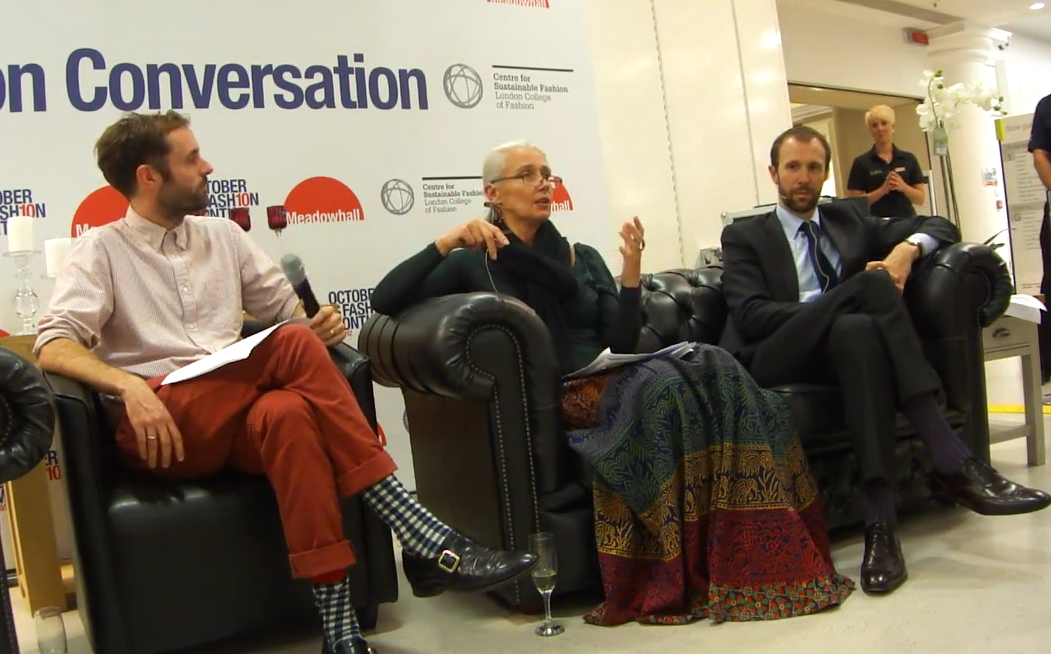
Alex McIntosh, Helen Storey and Mark Sumner discussing Catalytic Clothing
Behind closed doors, scientific research has been building bridges with the fashion industry in the latest step towards stylish sustainability.

Professor of Fashion and Science at The London College of Fashion, Helen Storey, and Pro-Vice-Chancellor for the Faculty of Science at the University of Sheffield, Tony Ryan, have put all their energy into a new product called CatClo which purifies the air around you by using clothing as a catalytic surface. 

In a series of exhibitions across the UK, Catalytic Clothing have placed this concept into the public sphere to see whether the fashion market is the way into sustainability and a way for the public to shape their own world. 

As part of October Fashion Month, the Catalytic Clothing Sheffield exhibition was held in Marks and Spencer at Meadowhall shopping centre. Helen and Tony joined the panel which included Grace Woodward, super stylist from the X Factor and Britain and Ireland’s Next Top Model, Mark Sumner, Sustainability Specialist for Marks and Spencer and Alex McIntosh from the centre of sustainable fashion at London College of Fashion, to discuss the development of the product. 


The Science behind Catalytic Clothing

The fashion industry is worth approximately £21 billion to our economy and it employs about 816,000 people. It is on par with the food and drink industry. ‘We all wear clothes’, Alex McIntosh said, ‘we all make a statement about who we are in the clothes that we buy and wear’. One of the key elements to the catalytic clothing concept is that it supports people’s need for fashion and consumerism with the aim of moulding this into a positive solution for pollution. 

‘In Sheffield, the nitric oxide level on average is above the limit set by the European Air Quality Standards which is 40 micrograms of nitric oxide per cubic metre’, Tony Ryan said. Nitric oxide is the chemical which is released from anything that is burnt, such as car exhausts and boilers. It can cause respiratory diseases, especially in young children and the elderly. Tony said, ‘Sheffield is really bad because of the geography of the city. it’s surrounded by hills and the pollution just sits in the valleys.’ 

The aim of Catalytic Clothing is to reduce this level of nitric oxide and the team aim to market the CatClo product as a laundry product which the consumer will wash their clothes in. This chemical is not harmful to clothes or skin and yet it breaks down air borne pollutants on contact, creating a cleaner atmosphere. 

There is about 9,000 tones of nitric oxide omitted into the atmosphere and we need to lose a thousand tones of nitric oxide a year to reach the standards set by the European Air Quality Standards. ‘If we were all wearing jeans like mine’, Tony said, ‘we’d be able to do it because this pair of jeans will take out five grams of nitrate oxide pollution’. Mark Sumner added, ‘we don't think that putting 3% organic cotton into a product is significant. it has to be more than that.’


The Red Planet Dress,
coated in the CatClo additive
The expression of fashion

Grace Woodward understands style more than most people. She believes that fashion ‘is a way in which we express ourselves and we have done since we started decorating ourselves with paint and mud.’ The product is not pushing the public to stop spending money and to stop taking pleasure in the things that people love ‘for the sake of the environment’, but the team identify and accept that consumerism is a way to break into the market.  She said ‘it promotes this huge desire in us which is sometimes irrational ... and I think that that’s so intrinsic in our DNA now.’ 

Recently, however, there has been a change in spending habits on the high street which have been of intrigue to the team. Mark Sumner said ‘the thing that has been interesting in chains on the high street is that people are taking more care of their products and their clothes and making them last longer and I think that’s a really interesting move in society’. 

The recession will have played a huge part in this shift in attitude towards consumerism and it is a great time for Catalytic Clothing to cease this opportunity. The vintage movement is continuously growing and the value of clothing, in terms of the meaning behind our clothes, is coming to the forefront. 


Reaching the public with a sustainable product

Scientific research is often very difficult to do at the same time as considering public views on a project and many new technologies are done behind closed doors for precisely this reason. However, with a project in the development of sustainability and public involvement in the shaping of the earth, doing research behind closed doors is unable to get very far.

Helen said ‘what we’ve tried to do with Catalytic Clothing is have the conversation with the public before the technology gets here because there’s no point of coming up with something nifty if no-one’s going to use it. This method ensures that the public are provided with a product that they actually want. 

This is where culture and science must come together. It is about attracting the widest possible proportion of the public, because as Professor Ryan stated, one pair of purified jeans won’t help - everyone must participate in shaping a more sustainable world. 

The panel were questioned by the audience at the end of the discussion. The question of when this concept will become reality for the public was a common one amongst the audience. ‘We still need to create a business model’, Tony said. There is a long way to go in terms of how this product will be marketed, whether it will be marketed as a laundry product or as a product made available to retail businesses who can coat their brand in the additive. Helen said, ‘what we’ve done is we’ve taken every single reservation and every single yes but, yes but and applied that into what we’ve been doing with the science right from the start’. It is safe to say that the science is all there and the team know that the technology will work to improve sustainability. The challenge which Helen and Tony face now is how they make the science attractive to the consumer. 


by Laura Thompson